Constitutive Coordination
Where capacities are constituted rather than located

The vocabulary that practitioners reach for when describing AI-mediated systems remains, in important respects, the vocabulary of pre-AI practice. The diagnostic categories were formed in human-only contexts and carry the structural assumptions of those contexts forward. One of the most persistent of these assumptions concerns where capacities live. The assumption operates almost invisibly. It nonetheless does substantial work in shaping what practitioners can diagnose and what they cannot.
This essay names a position the assumption excludes, argues that the position is necessary for diagnosing AI-mediated coordination, and offers a working vocabulary for it.
The Locus Assumption
Two positions organise most of the discourse on intervention in complex systems. The first holds that the practitioner supplies what the system lacks, namely the diagnosis, the methodology, the vision, the plan. The second holds that the practitioner creates conditions in which what is already present in the system becomes operative. The labels are theological. Augustinian for the first. Pelagian for the second. The original fifth-century dispute concerned divine grace and the human capacity for moral action. Augustine held that the capacity required assistance from outside the human will. Pelagius held that the capacity was native and required cultivation rather than supplementation. The Council of Carthage in 418 ruled against Pelagius. The categories have persisted, with the theological content stripped away, as a way of thinking about the relationship between intervention and capacity.
Applied to intervention in complex systems, the binary asks where the capacity for change lives. The Augustinian answer locates capacity outside the system in the expert, the methodology, the imported vision. The Pelagian answer locates capacity inside the system in the existing relationships, the latent potential, the practitioner’s restraint. Different traditions weight the two positions differently. The contemporary complexity-informed strand of practice has positioned itself firmly on the Pelagian side, in conscious opposition to a consulting industry it characterises as Augustinian.
Both positions treat the location of capacity as the question. They disagree about where. They agree that capacity is located. Both presuppose a stable host. The capacity exists somewhere before the intervention begins, and the intervention’s task is either to bring it in or to release it. The binary’s analytical work depends on this shared assumption.
The assumption is the locus assumption. Capacities are properties of stable hosts. The diagnostic question is which host.
Where the Locus Assumption Fails
A capacity that is real, operational, and consequential need not be located in either party in advance.
Consider a community whose work is partly shaped by AI tools. Documents are drafted with AI assistance and edited by human readers. Decisions are scoped through machine-generated summaries and finalised through human judgement. Patterns are surfaced by classifiers and interpreted in human conversations. The capacity for coherent collective action that this community exhibits is not a property the community holds in advance of the coupling with the AI infrastructure. It is not a property the AI infrastructure holds in advance of the coupling with the community. The capacity emerges in the coupling, for as long as the coupling functions, and degrades when it does not. The community has organised itself around the coupling. The capacities the coupling sustained are not available without it.
The Pelagian frame instructs the practitioner to create conditions for what is already present in the system to become operative. But what is already present, in an AI-mediated community, is partly constituted by the AI mediation itself. The presence the practitioner is supposed to release is not the community’s alone. It includes the coupling.
The Augustinian frame instructs the consultant to supply what the system lacks. But what the consultant supplies in an AI-mediated context is itself partly shaped by AI tools the consultant uses, AI-mediated information the consultant draws on, and AI-shaped conventions the consultant has internalised through training and practice. The supply the consultant performs is not their own. It includes the coupling.
The binary’s vocabulary describes a coordination structure in which the parties are discrete. Augustine’s grace comes from outside the human. Pelagius’s capacity is inside the human. The boundary between inside and outside is given. In AI-mediated coordination, the boundary is precisely what cannot be assumed. The capacities that matter are constituted in the coupling that crosses the boundary.
The Lee Sedol case makes the same point at higher resolution. What was taken from Sedol during the AlphaGo match was not a capacity he held in advance of the match. It was a capacity that had previously been constituted in the coupling between him and his historical opponents, a coupling that included shared training traditions, shared cultural framing, shared somatic registers of opponent-reading. AlphaGo did not enter that coupling. It performed Go moves in a relation that lacked the constitutive structure Sedol’s capacity required. Move 37 in game two made this concrete. Professional commentators initially assessed the move as a mistake. No human player would have produced it. No human gameplay had prepared a response to it. The move sat outside the constitutive structure that had previously sustained expert Go. It turned out to win the game. The Pelagian frame cannot diagnose what was taken because the Pelagian frame attributes Sedol’s capacity to Sedol. The Augustinian frame cannot diagnose it because the Augustinian frame would supply Sedol with a missing resource, and the missing resource was not a resource. It was a relation.
The Third Position
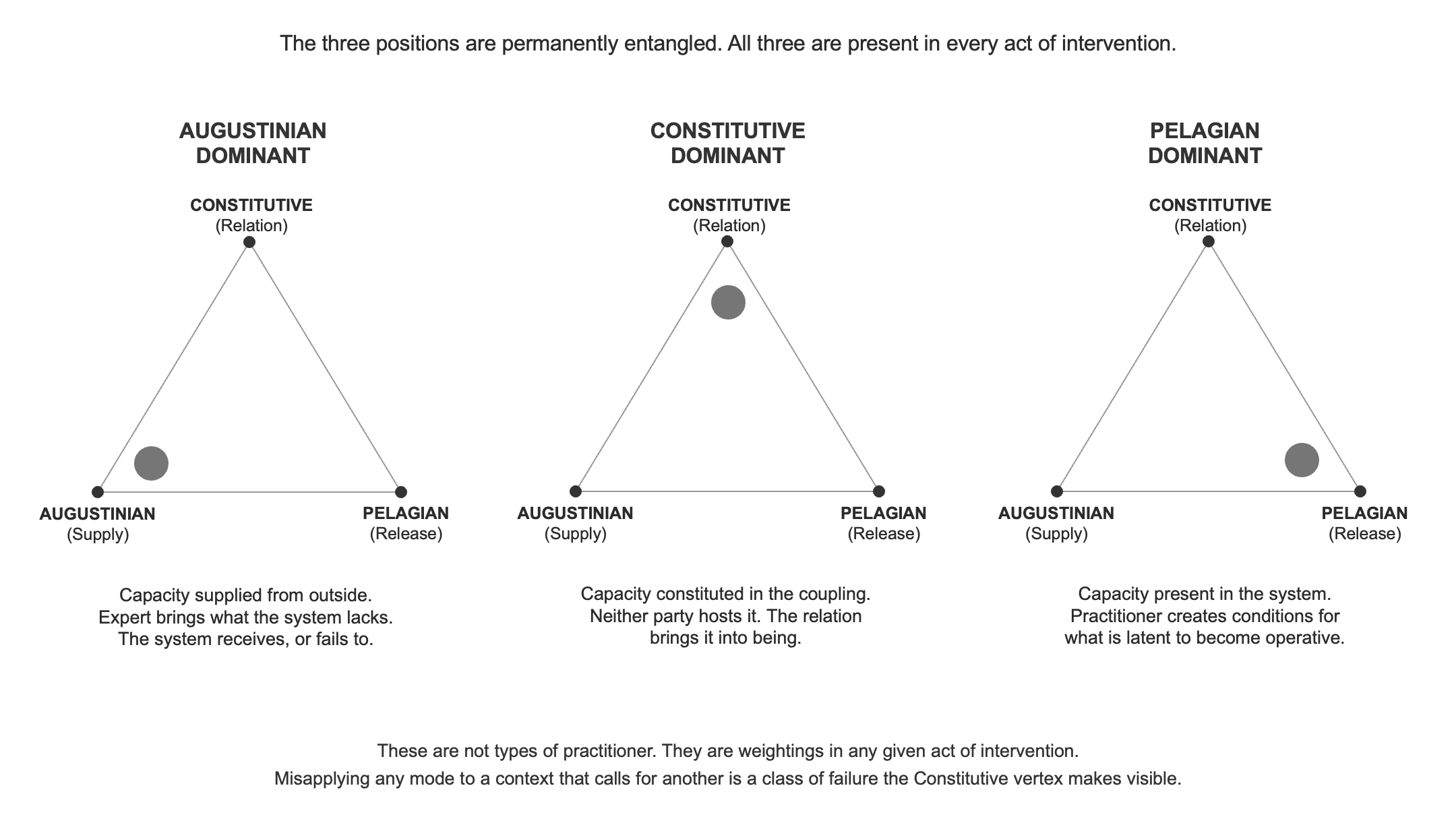
The third position holds that some capacities are constituted in coupling. The capacity is not supplied by the practitioner from outside. The capacity is not released by the practitioner from inside the system. The capacity is brought into being by the relation between intervenor and intervened, between human actors and nonhuman actors, between actors and the structured situations in which they meet. Neither party holds the capacity in advance. Neither party hosts it after the relation dissolves. It exists in the coupling, for as long as the coupling holds.
This is not synthesis. The dialectic move of finding a higher unity that includes both prior terms is not what is being proposed. The constitutive position is a different commitment about where capacities live. The locus assumption is the assumption that capacities are located. The constitutive position does not relocate capacity. It says that some capacities are not located. They are constituted.
The technical literature has names for what the constitutive position describes. Maturana and Varela’s structural coupling describes how systems develop capacities through reciprocal interaction with each other and with their environments. The capacity is a property of the coupling, not of either party. Latour’s actor-network theory generalises this commitment across heterogeneous actors. The capacity to act is constituted in the network. It is not held by any single actor in advance of the network’s operation. Andy Clark’s extended mind thesis, the philosophical cousin of the 4E cognition tradition that intervention theory has begun to cite, makes the same move at the level of cognition. The cognitive capacity extends across the coupling between the biological organism and its tools, scaffolds, and environments. The capacity is not located in the brain. It is not located in the tool. It is located in the relation between them.
What the Constitutive Position Makes Visible
The constitutive position enables three diagnostic moves the binary cannot make.
The first is the diagnosis of capacities that are real, operational and consequential without being locatable in either party. The community’s capacity for coherent action under AI mediation is one example. The classifier’s capacity to surface relevant patterns is another. The capacity is not in the data, not in the model, not in the deployment context alone, but in their combination. The binary’s question of where the capacity lives produces no useful answer. The constitutive question of how the coupling sustains the capacity produces a tractable diagnostic.
The second is the diagnosis of failure modes specific to coupled systems. When AI mediation degrades, the community’s coherence does not return to a pre-coupling baseline. The community has organised itself around the coupling. The capacities the coupling sustained are not available without it, and the community lacks the resources to reconstitute them rapidly because those resources were partly constituted in the coupling that has degraded. The Pelagian frame cannot diagnose this because the Pelagian frame assumes the community’s capacities pre-exist the intervention. The Augustinian frame cannot diagnose it because the Augustinian frame assumes the consultant’s intervention is separable from the system’s response. The constitutive frame names the dependency directly.
The third is the diagnosis of capacities that emerge under conditions neither party intended. The classifier’s surface of patterns may include patterns no human reader was looking for. The community’s coordination may produce behaviours no member designed. These are not glitches to be corrected. They are constitutive products of the coupling. The constitutive frame treats them as proper objects of diagnosis. The binary frame attributes them either to the human side, where they are seen as emergent properties of the social system, or to the AI side, where they are seen as algorithmic outputs, and loses what they actually are, which is the capacity of the coupling to produce what neither party can produce alone.
A Trialectic
The position the binary excludes can be added without abandoning what the binary captures.
Some contexts are genuinely Augustinian-weighted. The system lacks something that exists outside it and can be brought in. The expert who understands a regulatory regime, a technical specification, or a domain the system has not yet encountered is doing legitimate Augustinian work. The supply is not always wrong. The supply is wrong when the work has been misdiagnosed.
Some contexts are genuinely Pelagian-weighted. The system contains capacity that has been suppressed, ignored, or routed around. The practitioner who creates conditions for what is latent to become operative is doing legitimate Pelagian work. The release is not always wrong. The release is wrong when the capacity the practitioner attributes to the system is not in fact the system’s alone.
Some contexts are Constitutive-weighted. The capacity that matters does not yet exist in either party. The coupling has not yet been formed, or has formed and degraded, or is forming under conditions the parties have not yet recognised. The practitioner’s work is to participate in the constitution of the coupling that will sustain the capacity. This work is neither supply nor release. It is participation in the relation that brings the capacity into being.
The three positions form a trialectic. Augustinian, Constitutive, Pelagian. The term is used here in the Peircean register, naming three ontologically distinct positions held in permanent tension, rather than in the Hegelian register of moments resolved through synthesis. The three positions co-exist as diagnostic lenses. They do not collapse into a higher unity. Every act of intervention carries some weight at each vertex. The diagnostic question is which vertex carries the most active weight in a given situation. The misapplication problem applies in three directions. Treating a Constitutive context as Pelagian attributes to the system capacities the coupling has not yet produced. Treating a Constitutive context as Augustinian supplies resources to a system that needs a relation rather than a resource. Treating a Pelagian context as Constitutive defers indefinitely on capacities that are present and could be released. Treating an Augustinian context as Constitutive declines to bring in resources that the system genuinely lacks and cannot constitute from its own materials.
What constitutive practice looks like in the field is its own substantial question and is not the subject of this essay. The practitioner whose work is constitutive does not supply a resource and does not release a latent capacity. The practitioner participates in the conditions under which a coupling can form, hold, or be repaired. This work has some recognisable features. Attention is paid to the relational structures between heterogeneous actors, not to the actors taken separately. Interventions are reversible and read for their effect on the coupling rather than on either party. Failure is diagnosed as failure of the relation rather than as failure of supply or failure of release. The technical literatures the constitutive position draws on (structural coupling, actor-network theory, the extended mind) carry methodological commitments that can be developed into practice protocols. That development is work for another piece and for other practitioners. What this essay establishes is the diagnostic position the practice presupposes. The practice will be sharper for having the position named.
The recent five-post series on three-term structures, which is part of the wider context in which this essay has been developed, has argued that binaries produce diagnostic errors and that three vertices track ontological distinctness more honestly. The argument has not yet been applied to the Augustinian/Pelagian binary that organises much of the contemporary intervention discourse.
What the Trialectic Reaches
The Constitutive vertex is the position the AI-coordination gap has been waiting for.
The vocabulary practitioners reach for when describing AI-mediated systems remains indexed to human-only practice in ways that are increasingly difficult to defend. Coordination opacity, the structural displacement of accountability, automation bias, performative oversight, the rest of the failure-mode catalogue that has accumulated in the AI-coordination literature, all of these phenomena are constitutive products of the coupling between human and nonhuman actors. None of them is a property of either party alone. The binary’s vocabulary cannot reach them because the binary’s vocabulary assumes a clean-edged separation between parties. The Constitutive vertex names the location the binary cannot occupy.
The systems that intervention practitioners work in are increasingly coupled with infrastructures whose constitutive contributions the practitioner’s vocabulary cannot reach. The choice is between extending the vocabulary or losing the diagnostic. The Constitutive position is the extension. Neither supplied nor released but constituted in the coupling that makes the capacity available. Constitutive coordination is what the AI-mediated case requires. The Constitutive position is what makes it sayable.